By Amit Kumar Deshwal · Updated August 15, 2026
Sugam Darshan passes for Shri Ram Janmabhoomi Temple are booked by our team every single day, and everything set out below is drawn from that daily work rather than a single visit — the eight slot timings and what each one is actually like, the three aartis and the passes they require, and the details at the gate that decide whether a darshan is calm or stressful. If you would rather the booking simply be handled for you, that is what we are here for.
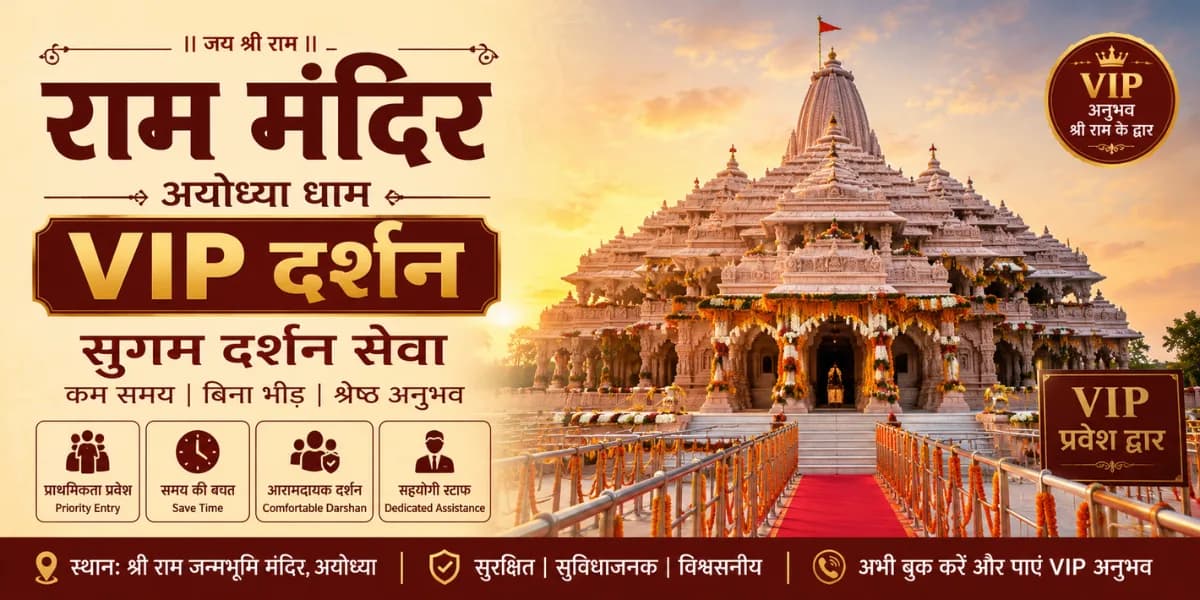
Ram Mandir VIP Darshan and Sugam Darshan are the same free pass — there is no paid VIP ticket. Slots open roughly 10–15 days ahead of the visit date. The temple closes 12:00 PM to 1:00 PM for Bhog. The three daily aartis are Mangala 4:00 AM, Shringar 6:00 AM and Shayan 10:00 PM, each needing its own free pass. Anyone charging money for a “Ram Mandir VIP pass” is fraudulent.
Darshan Hours
7 AM – 9 PM
Pass Cost
Free
Official Site
online.srjbtkshetra.org
Booking Window
10–15 days ahead
Not one category of entry at Ram Mandir carries a price. Sugam Darshan, Samanya Darshan and all three Aarti passes are issued free by the Shri Ram Janmbhoomi Teerth Kshetra Trust, and only at online.srjbtkshetra.org. There is no paid VIP tier held back for agents, no donation that opens a faster lane, and no reserved quota anyone can sell you. The test is simple: a payment page never appears on the genuine portal at any stage of a darshan booking, so if one appears in front of you, the tab should be closed.
Where our fee sits is worth stating plainly. The pass is booked in your own name, on the official portal, at no cost — what is charged for is the midnight booking coordination, transport, guide and hotel arrangements built around your confirmed slot. That distinction is the whole difference between a service and a scam.
Once Ram Mandir opened on 22 January 2024, the arithmetic became impossible to ignore. Upwards of a lakh devotees were reaching the complex on ordinary days, and multiples of that during festivals, all converging on a single sanctum. No open queue absorbs that. Sugam Darshan is the system the Trust built in response.
What the pass does is convert an unknown wait into a fixed appointment. A two-hour window is reserved in your name, free of charge, and entry is made through a dedicated gate rather than the open line. The difference is felt most acutely by the people it was designed for — elderly parents, families with small children, anyone with a train to catch the same evening.
It should be understood for what it is, though. No devotee is given more time before Ram Lalla than any other; the garbhagriha is passed through at one pace for everyone. What is being saved is the waiting, not the darshan itself. Once that is clear, the claims made by sites selling a “premium” version of this pass tend to fall apart on their own.
Sugam Darshan Pass
Official — completely free
Your pass is valid only inside the slot printed on it, which makes this table the thing your whole day in Ayodhya gets planned around. The notes below are ours, drawn from booking these slots daily — not copied from the portal. Timings are adjusted during festivals and between seasons, so verify close to your travel date.
The slot every family asks us for. Cool air, thin queue, and the whole day still ahead of you afterwards. It is also the first slot to disappear when a date opens.
A gentler start for anyone who does not want a pre-dawn alarm. The crowd is building by now but the queue still moves at a reasonable pace.
Only one hour wide, and it ends the moment the sanctum closes for Bhog. Late arrivals here have no cushion at all — be at the gate early or not at all.
The sanctum shuts for Bhog. No entry is permitted during this hour, and this is the single most common thing devotees are not told before they travel.
Quietly the most underrated slot of the day. The post-Bhog crowd is noticeably thinner than the evening rush, and it is often still open when mornings have gone.
The heat begins to ease towards the end of this window. A sensible choice for families arriving in Ayodhya around midday.
The light on the sandstone at this hour is something photographs never quite carry. Pairs naturally with the Saryu Aarti at Ram Ki Paidi afterwards.
The final entry of the day, with the complex fully illuminated. Weekends here are busy, but the atmosphere after dark is worth the crowd.
Summer schedule (April–September). Aarti timings shift by 30–60 minutes in winter.
Mangala Aarti
4:00 AM
Summer
Ram Lalla is woken before the city is. Four in the morning, the courtyard almost silent, conch and bells carrying further than they ever do later in the day — devotees who have attended it tend to describe this one rather than the others when they get home. The gathering is small and strictly screened, which is exactly what gives it that quality.
Free pass required and hardest of the three to secure — report at the gate by 3:30 AM
Shringar Aarti
6:00 AM
Summer
Shringar means adornment, and that is precisely what is happening — Ram Lalla dressed in fresh garments, ornaments and flowers for the day ahead. This is the aarti we most often steer families and elderly parents towards. The devotional weight is entirely there, the hour is humane, and it runs straight into the 7:00 AM darshan slot.
Free pass required, availability noticeably better than Mangala — report by 5:30 AM
Shayan Aarti
10:00 PM
Summer
The closing ritual, performed as Ram Lalla is put to rest and the temple prepares to shut for the night. Shayan means sleep and the ceremony carries that register — quieter and gentler than the morning aartis. Far fewer pilgrims stay overnight in Ayodhya, which is why these passes are the easiest of the three to get.
Free pass required, best availability of the three — report by 9:30 PM
Ram Mandir Aarti Timings — Quick Reference (Summer 2026)
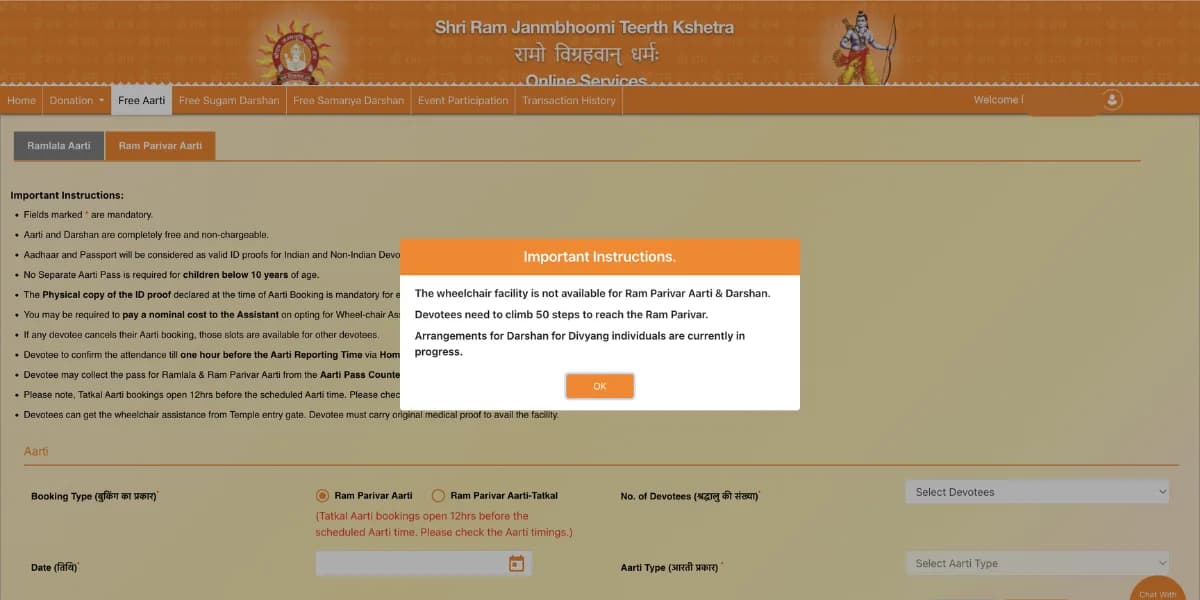
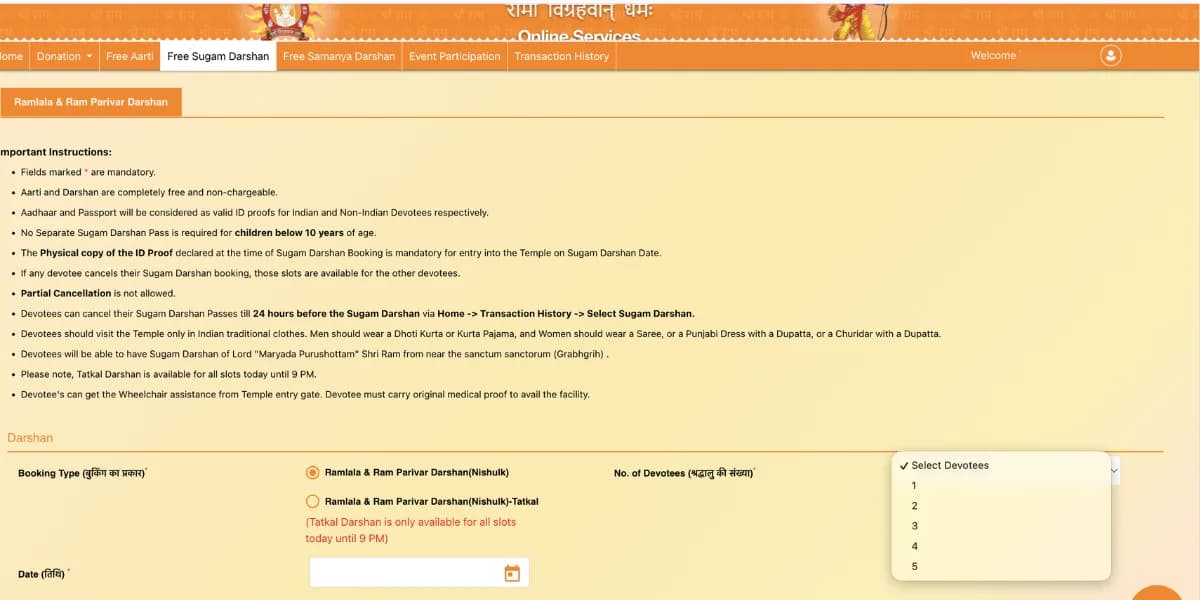
Aarti passes are booked on the exact same portal as Sugam Darshan — online.srjbtkshetra.org — but as a separate option on the dashboard. Log in with your mobile number and OTP, choose Aarti Pass instead of Sugam Darshan, pick which of the three aartis you want and your date, then enter each devotee’s details exactly as on their ID, the same as any other booking.
The screenshot beside this is the actual Ram Parivar Aarti booking screen, not a mock-up — it’s what you’ll see once you select Aarti Pass on the portal. Seating for aarti is a fraction of what Sugam Darshan slots hold, so these bookings move fast, especially for Mangala Aarti, and we’d rather you know exactly what the form looks like before you’re sitting there at midnight trying to fill it in for the first time.
Proof, Not a Promise
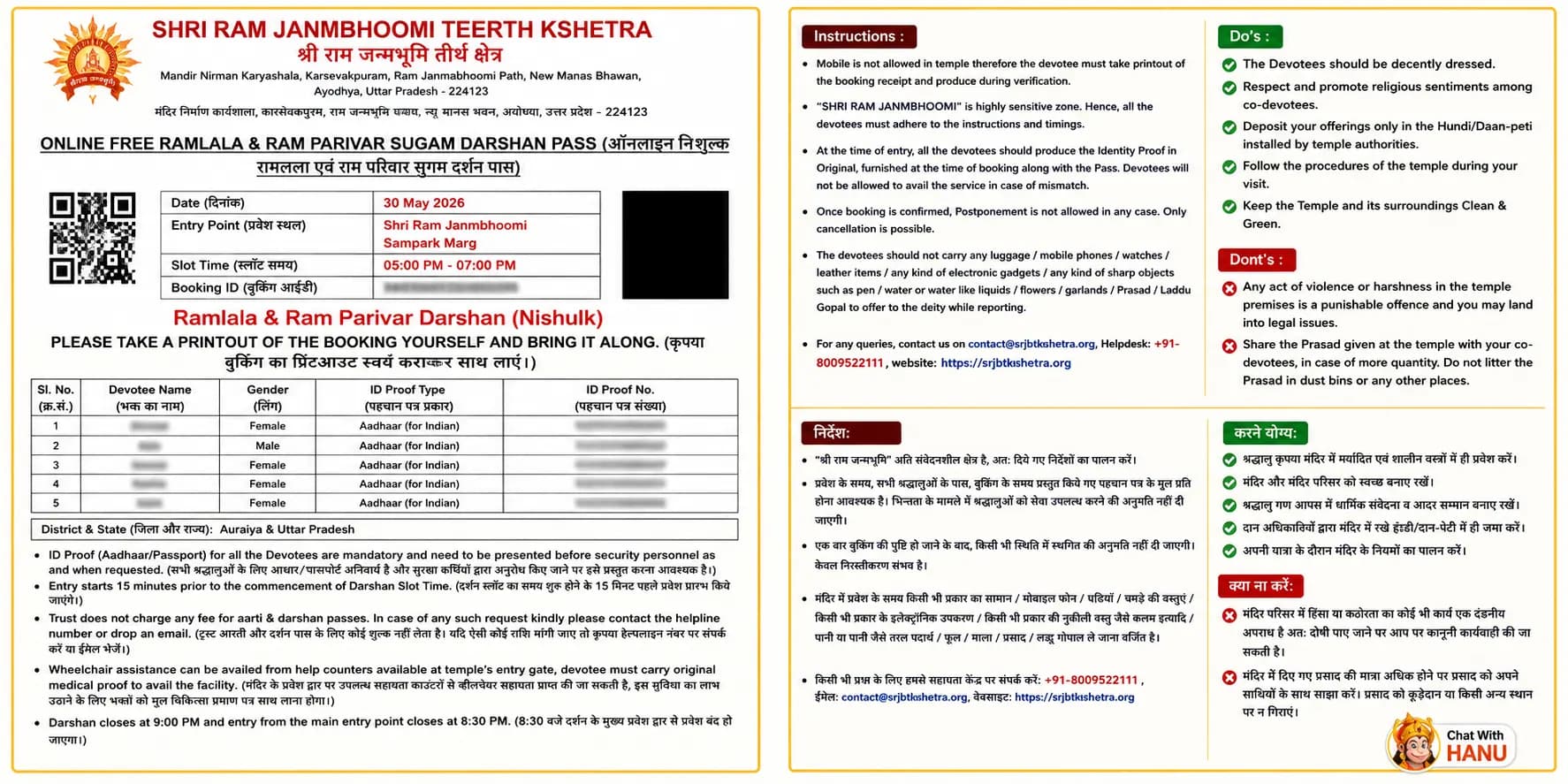
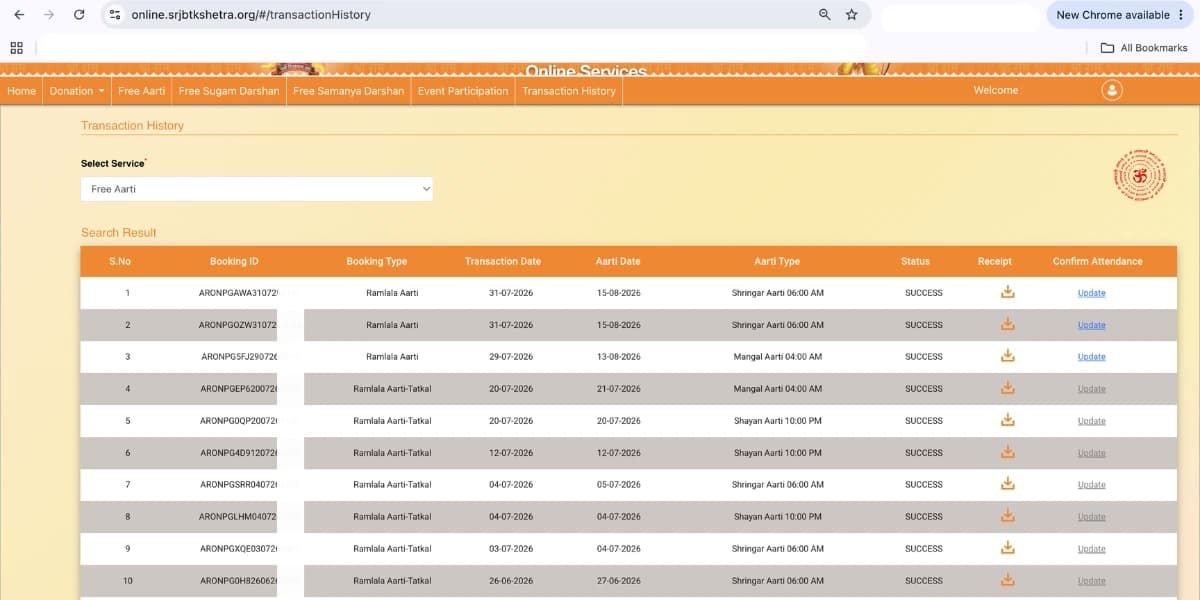
This is our own aarti-pass booking history, not a sample or a screenshot borrowed from somewhere else. Mangala Aarti at 4 AM, Shringar at 6 AM, Shayan at 10 PM — we book all three for guests daily, including on the nights aarti seating disappears within minutes of release. If you want us to book yours instead of racing the midnight release yourself, call +91 90584 30503.
online.srjbtkshetra.org is the only address that issues these passes. It looks plain, and that plainness is a reliable signal — no payment gateway appears at any stage, because nothing is being sold. Any page asking for card details is not the Trust's.
Eight slots are offered per date, from 7 AM through to 9 PM, with the sanctum closed 12–1 PM. Dates enter the booking window roughly 10–15 days ahead, released around midnight. The 7–9 AM slot goes first, on practically every date.
Name, age, gender and Aadhaar number for every devotee, matching the identity document letter for letter. Up to 8 devotees fit under one mobile number. Foreign nationals and NRIs enter passport numbers instead.
Save the pass to your phone's gallery so it opens without a signal, and carry a printout as backup. Network coverage around the complex collapses under crowd load, and a pass that will not load is a pass you do not have.
Open online.srjbtkshetra.org on your phone or laptop and you land on a fairly plain government portal — no flashy design, no pop-ups asking you to subscribe to anything. That plainness is actually a good sign; it’s one of the ways you know you’re on the real site and not one of the lookalike pages that show up in search results and paid ads every festival season. The first thing you’ll notice is that there is nowhere to enter card details. There never will be, because the pass is free — if a site asks you to pay before it shows you a darshan slot, you are already on the wrong page.
Registration is just your phone number and an OTP. No password to invent, no security questions, nothing to forget by the time your travel dates come around. We’ve had guests call us confused because they expected an email confirmation or a login screen — there isn’t one. Your mobile number is the account. If you’re booking from outside India for family travelling in, this is the part that trips people up, because the OTP only reaches Indian SIM numbers. We usually end up using a relative’s number on their behalf, or our own, and then forwarding the confirmed pass to them directly.
Once you’re in, you’ll see Sugam Darshan and Aarti Pass sitting as two separate options on the dashboard — this is where most self-booked trips quietly go wrong. People assume booking one gets you both, tick the Sugam Darshan box, and only realise at the temple gate that the aarti they were hoping to attend needed its own pass entirely. Pick Sugam Darshan for darshan of Ram Lalla; if aarti matters to you, you’ll need to come back and book that separately, on the same portal.
Choosing a date shows you eight slots for the day, and here’s something we’ve watched happen on the screen in real time, more times than we can count — the 7:00 AM to 9:00 AM slot is usually the first one to grey out, sometimes within minutes of a new date opening. It’s not a coincidence. That slot means cooler weather, a calmer temple and a full day left afterwards, so everyone wants it. If you see it available, take it before you do anything else on the page — don’t go back to compare, because it may not be there when you return.
Entering devotee details is the slow part, and it’s worth being genuinely careful here rather than fast. Name, age, gender and Aadhaar number, for every person in the group, typed exactly as printed on the ID — not a nickname, not how the family usually writes it. We have watched a guest get turned away at the gate over a middle name that was on the Aadhaar card but left off the booking form. The staff checking IDs at the entrance are matching two documents against each other, and they have no discretion to wave through something that doesn’t match exactly, however small the difference looks to you.
The last step is downloading the QR pass, and this is the one people treat as optional and shouldn’t. Save it to your phone’s photo gallery, not just to an email you’ll open later — mobile networks around the temple complex get overloaded on any day with a decent crowd, and “I’ll just pull it up when I get there” has left more than one family standing at the gate trying to load a page that won’t come through. A printed copy in your bag costs nothing and has never once let us down.
Official booking URL: online.srjbtkshetra.org — This is the only legitimate source. Passes are free. Slots typically open 10–15 days in advance. During Ram Navami, Diwali and other major festivals, slots are exhausted within minutes — plan accordingly.
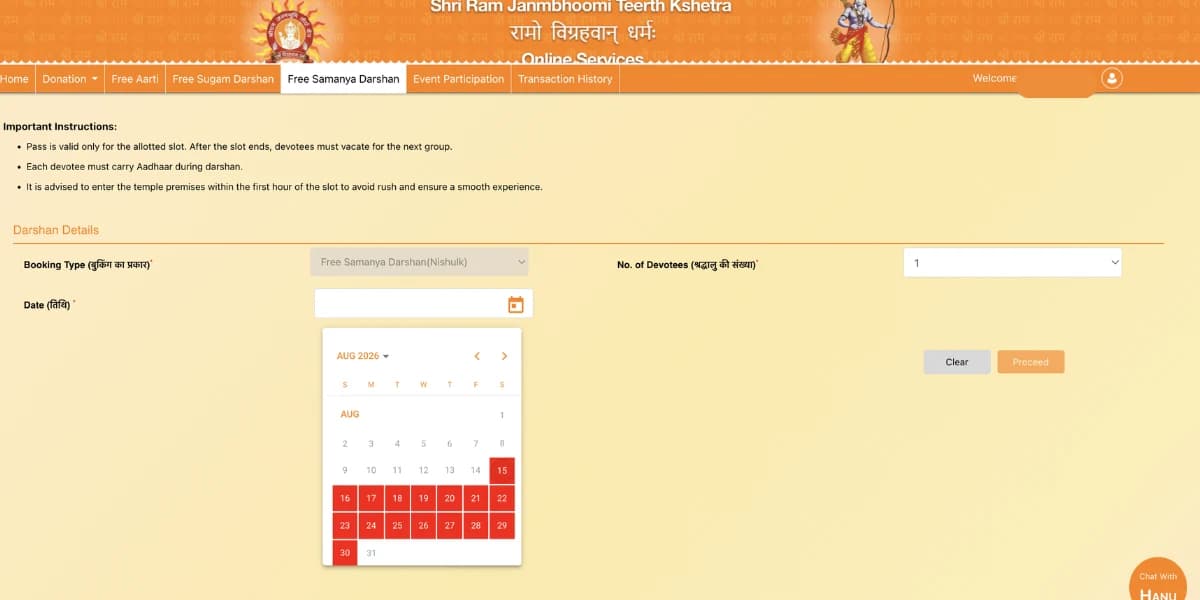
Samanya Darshan is a newer category the Trust has added on the same official portal, alongside Sugam Darshan and the Aarti passes. “Samanya” means “general” — this is the general darshan queue, but now with online slot registration rather than simply joining a physical line with no booking at all.
It does not carry the priority-gate benefit that Sugam Darshan gives you, and the wait is closer to the general-queue timing than the Sugam timing. What it does give you is a registered slot and QR entry instead of joining an unbooked crowd, which the Trust has been rolling out as part of the same online system.
We book Samanya Darshan passes on the official portal exactly the way we book Sugam Darshan and Aarti passes — same process, same free cost, same devotee-detail accuracy required. If you are unsure which category suits your dates and group, call us and we will book the right one.
Men: Kurta-pyjama or dhoti-kurta sits most naturally here. Trousers and a plain shirt are perfectly acceptable — shorts and sleeveless vests are not.
Women: Saree or salwar-kameez, or any full-length modest clothing with shoulders covered. A dupatta is worth carrying regardless of what else is worn.
Nothing is turned away at the gate over clothing, but the Janmabhoomi is treated with a certain seriousness by everyone around you, and dressing accordingly is quietly noticed.
How you arrive shapes which slot you can realistically hold. The notes below reflect how our guests actually travel these routes — not just the distances.
Delhi
~638 km
Vande Bharat Express runs New Delhi to Ayodhya Cantt in around 7.5 hours and is comfortably the best option. Avadh Express and Kashi Express also serve the route. Both Ayodhya Junction and Ayodhya Cantt sit roughly 2 km from the temple.
NH-27 via the Lucknow Expressway, 8–9 hours behind the wheel. Worth starting before dawn if you intend to make a morning slot.
Guests who take the Vande Bharat consistently arrive fresher than those who drive. For a 7 AM slot, travel the previous day rather than overnight.
Lucknow
~135 km
Frequent daily services, 2 to 2.5 hours — Gomti Express and the Intercity are the usual choices.
The Lucknow–Faizabad highway takes 2 to 2.5 hours. Taxis and UPSRTC buses both run the route regularly.
Lucknow remains the busiest airport near Ayodhya. Fly in, take a car onward, and a morning darshan the following day is entirely comfortable.
Varanasi
~200 km
Regular services take 3 to 4 hours, including the Sabarmati and Pushpak Expresses.
NH-27, roughly 3.5 to 4 hours by car.
This is the leg most of our guests travel. Ayodhya and Varanasi together — with Prayagraj slotted between them — make the circuit almost everyone ends up booking.
Prayagraj
~165 km
Regular trains via Ayodhya Dham Junction, 3 to 4 hours.
NH-330 into NH-27, about 3 to 4 hours by road.
The shortest hop of the circuit. Triveni Sangam in the morning and Ayodhya by evening is a realistic single day if the timings are planned properly.
Gorakhpur
~140 km
Several daily services, around 3 hours to Ayodhya Dham Junction.
NH-27, roughly 3 hours by car.
A useful entry point for devotees continuing on to Nepal or the Buddhist circuit at Kushinagar afterwards.
E-rickshaws are the primary local transport. ₹20–50 per ride to Ram Mandir from railway station or bus stand. Regular city buses also run to Ram Janmabhoomi Path.
Large designated parking lots near Ram Mandir. On peak days, parking fills by 8–9 AM. Use Ram Janmabhoomi Parking Lot 1 or 2. E-rickshaw from railway station avoids parking entirely.
Maharishi Valmiki International Airport, Ayodhya — opened 2023. Flights from Delhi, Mumbai, Ahmedabad. Alternatively, fly to Lucknow (135 km, ~2.5 hrs taxi).
Nearly all of these sit within walking distance or a short e-rickshaw ride, which is why a half-day covers them comfortably. The order we suggest is Hanuman Garhi first, then Ram Lalla, closing at Ram Ki Paidi for the evening Saryu Aarti.
Tradition asks that Hanuman's blessing be sought before Ram Lalla's, which is why we sequence it first. Seventy-six steps to the top, no lift, and worth knowing that in advance if elderly parents are travelling.
Said to have been gifted to Sita by Queen Kaikeyi after the wedding. Spacious, unhurried and considerably calmer than the main complex — guests often linger here longer than they planned to.
A small shrine built around what is held to be Mata Sita's kitchen. Brief to visit, easy to fold into the Kanak Bhawan walk, and quietly moving in a way its size does not suggest.
The palace complex of King Dashrath, Ram's father. Modest in scale but heavy with association for anyone who grew up on the Ramayana.
Established according to tradition by Kush, Ram's son, and among the oldest continuously worshipped sites in Ayodhya. Shivratri here is extraordinary.
The ghat complex on the Saryu where the evening aarti is performed. During Deepotsav, lakhs of lamps line these steps — the images that travel worldwide are shot here.
Believed to be where Lord Ram took Jal Samadhi. Downstream, far quieter than Ram Ki Paidi, and the better choice if crowds are wearing on you by the end of the day.
A memorial to Sant Tulsidas, who gave us the Ramcharitmanas. Regular evening Ramlila performances make it a gentle way to close a day of temple visits.
Temple Name
Shri Ram Janmabhoomi Mandir
Location
Ram Janmabhoomi Path, Ayodhya, UP
Inaugurated
22 January 2024
Entry Fee
Free for All Pilgrims
Sugam Darshan
Free — online.srjbtkshetra.org only
Samanya Darshan
Free — same official portal
Booking Window
Opens ~10–15 days ahead
Darshan Hours
7:00 AM – 9:00 PM
Midday Closure
12:00 PM – 1:00 PM
Mangala Aarti
4:00 AM (Summer)
Shringar Aarti
6:00 AM (Summer)
Shayan Aarti
10:00 PM (Summer)
Nearest Railway
Ayodhya Junction (~2 km)
Nearest Airport
Maharishi Valmiki Airport, Ayodhya
Photography
Outer complex only
Dress Code
Modest traditional attire
Footwear
Removed at temple entrance
Best Time to Visit
Oct–Mar, weekday mornings
Most of the anxiety first-time devotees carry comes from simply not knowing the sequence. Set out below is what actually happens, in order, from the gate to the moment you walk back out.
Screening here is run to airport standards and is not negotiated. Bags go through the scanner, footwear is deposited separately, and every devotee passes through a metal detector. The staff are courteous about it, but nothing prohibited gets through — phones included. Twenty to thirty minutes should be allowed for this on any day with a crowd.
The fastest devotees through this line are the ones carrying nothing but a pass and an ID. Leave the rest at the hotel.
Beyond security the path opens onto the parikrama circling the main temple, laid in pink Bansi Paharpur sandstone that stays surprisingly cool underfoot even in May. It is from this stretch that the 161-foot shikhara is first seen properly, and it is longer than most photographs suggest — a genuine walk, not a few steps.
This is where the carving detail is worth slowing down for. Once you are in the darshan line, there is no pausing.
The queue tightens as the inner sanctum nears and the pace becomes managed rather than self-directed. Volunteers and staff keep the line moving steadily. There is a noticeable change in the sound around you here — the general noise of the complex drops away and what is left is largely chanting.
Keep your group together before this point. Once the line narrows, regrouping is not practical.
Ram Lalla is seen in the child form, carved in dark stone by Arun Yogiraj and consecrated in January 2024, dressed in silk and ornaments with fresh flowers. The idol is clearly visible from the line. The moment itself is brief — the same brief for every devotee in the building — and it is the reason the entire journey was made.
No photography is possible here, which most people find is a mercy rather than a restriction.
The route out passes Ram Darbar on the first floor and then the smaller shrines within the complex — Kaushalya Mata, Lakshmana, Bharat, Shatrughan, Hanuman Ji and Sita Mata. Ram Darbar is included in the same pass and needs no separate booking, and devotees who do not know it is there routinely walk out having missed it.
Budget 45 to 60 minutes for the complete circuit rather than leaving straight after the sanctum.
March / April
Ram's birthday, and the single heaviest day in the Ayodhya calendar — five to ten lakh devotees, extended darshan hours and an aarti unlike any other date. Slot inventory has emptied within fifteen minutes of the midnight release in recent years. Details must be pre-saved and pasted, not typed.
October / November
Deepotsav is what Ayodhya has become globally known for — lakhs of diyas along the Saryu ghats, a record broken most years, and the whole complex lit. Accommodation anywhere walkable disappears well before the slots do, so the hotel is booked first and the pass second.
November / December
The marriage of Ram and Sita, with the temple dressed as a wedding house. Quieter in scale than Ram Navami but emotionally the most affecting date of the year for many devotees. Footfall stays heavy across two to three days rather than peaking on one.
Best Season
If the dates are yours to choose, choose these months. Cool, dry air makes the parikrama walk and the nearby temples genuinely pleasant rather than something to endure. A weekday morning slot in February is about as calm as Ram Mandir ever gets.
Summer (Avoid midday)
Genuinely punishing, with temperatures crossing 44°C and stone underfoot that holds the heat. Travelling with elderly parents in these months is not something we encourage. If the dates cannot move, only the 7–9 AM slot is advisable, finishing well before eleven.
January
The Paush full moon, when a dip in the Saryu carries particular merit. Pairing the snan at dawn with a morning darshan slot makes for one of the more complete days available in Ayodhya — and it draws crowds accordingly.
Very few devotees travel all the way to Ayodhya and stop there. Prayagraj and its Triveni Sangam sit close enough to fold in without strain, and Varanasi extends it into the circuit most of our guests end up booking. Four to six days covers all three at a pace that still leaves room to sit down.
Ayodhya
Ram Mandir Sugam Darshan, Hanuman Garhi, Saryu Aarti
Travel to Prayagraj
~160 km, ~3 hrs — Triveni Sangam snan & Bade Hanuman
Prayagraj → Varanasi
~120 km, ~2.5 hrs along the Ganga
Varanasi
Kashi Vishwanath darshan, Ganga Aarti, Sarnath
Book Your Full Circuit
Darshan booking is handled at every stop rather than only the first — Ram Mandir in Ayodhya, the Sangam at Prayagraj, Kashi Vishwanath in Varanasi — along with certified guides, AC transport and hotels placed to suit your slot timings.
160 km
Ayodhya → Prayagraj
120 km
Prayagraj → Varanasi
4–6
Days Ideal
Not a once-off visit written up as an article. Ayodhya Varanasi Guides has booked Ram Mandir Sugam Darshan, Samanya Darshan and Aarti passes every single day for two years without missing a day — through ordinary Tuesdays, Ram Navami mornings when slots emptied in eleven minutes, and Deepotsav week when the whole portal was under load. Everything on this page comes from that daily repetition, not a single trip.
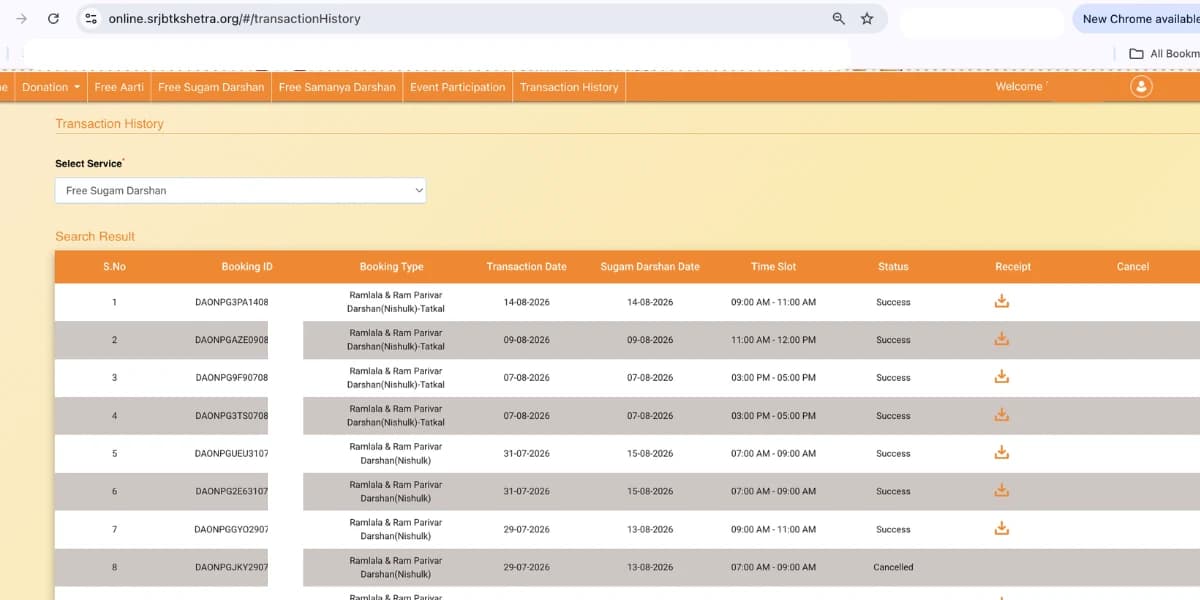
Our actual Sugam Darshan booking history — every date, booked in sequence, two years running.
This is a screenshot from our own booking account, not a stock image or a mockup.
2 Years
Daily Booking Record
3
Pass Types Booked Daily
0
Missed Days, Ram Navami Included
Real Proof, Not a Claim
We know how slot inventory behaves in the fortnight before Ram Navami, how to distribute a family of twenty across parallel bookings without splitting anyone, and which hotels are genuinely walkable at 3:30 AM for Mangala Aarti. That is what two years of daily booking actually buys — not something we could write convincingly after a single visit.
Written & Verified By
Amit Kumar Deshwal
Founder & Pilgrimage Travel Expert
Born in Uttar Pradesh. Has personally hosted more than 15,000 guests across Ayodhya, Varanasi, Mathura, Vrindavan and Agra.
1 Day Ayodhya Tour Package
From ₹2,499 per person
2 Days Ayodhya Tour Package
From ₹3,999 per person
3 Days Ayodhya Varanasi Tour Package
From ₹8,999 per person
Browse all Ayodhya tour packages or check current temple darshan timings.
Genuine reviews from devotees who trusted Ayodhya Varanasi Guides for their sacred yatra.
Sugam Darshan is the free, time-slot darshan system operated by the Shri Ram Janmbhoomi Teerth Kshetra Trust at Ram Mandir. Devotees holding the pass enter through a dedicated gate during a booked two-hour window instead of joining the open general queue. It was introduced because footfall regularly crosses a lakh a day, which no unmanaged queue could absorb. The pass is issued at no cost on online.srjbtkshetra.org.
Yes — they are two names for one facility. The Trust calls it Sugam Darshan; devotees, agents and search engines call it VIP Darshan. Ram Mandir operates no paid VIP tier, no priority donation lane and no agent quota. Anyone presenting VIP Darshan as a separate premium product is describing something the temple does not issue.
Nothing. Sugam Darshan, Samanya Darshan and all three Aarti passes are issued free of charge. The clearest way to verify a site is genuine is that the official portal never presents a payment page for a darshan pass — no card form, no UPI QR, at any stage. Sites listing rates of ₹100 to ₹1,000 are not quoting official prices.
Eight slots run daily: 7–9 AM, 9–11 AM and 11 AM–12 PM in the morning, then the sanctum closes 12–1 PM for Bhog, reopening for 1–3 PM, 3–5 PM, 5–7 PM and 7–9 PM. The midday closure catches out more travelling families than anything else about this temple, so it is worth planning lunch or Hanuman Garhi deliberately into that hour.
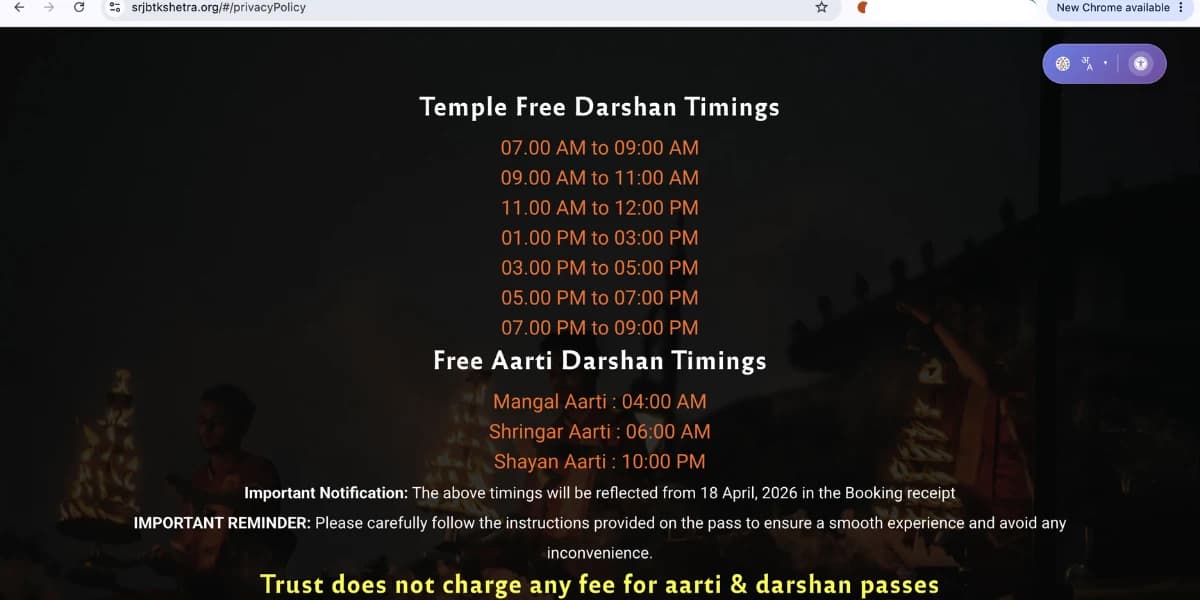
Three aartis are performed daily before Ram Lalla. Mangala Aarti at 4:00 AM is the pre-dawn awakening, Shringar Aarti at 6:00 AM is the adornment ceremony, and Shayan Aarti at 10:00 PM closes the day before the deity rests. Each requires its own free pass, booked separately from your darshan pass. Timings shift by roughly 30 to 60 minutes between summer and winter.
Dates enter the booking window roughly 10 to 15 days before the visit, released around midnight. Weekday slots typically remain available for a day or two afterwards. Weekend slots are usually gone the same night. Ram Navami and Deepotsav inventory has emptied within fifteen minutes of midnight in recent years.
The 7:00 AM to 9:00 AM slot, without much competition. The air is cool, the queue is at its thinnest, and darshan finishes before the day turns tiring. If that window has gone, the 1:00 PM to 3:00 PM slot is the sensible fallback — the post-Bhog crowd is thinner than the evening rush and it is frequently still open when mornings are not.
Every devotee aged ten and above must carry the original photo ID whose number was entered at booking. Aadhaar clears verification fastest for Indian citizens; Voter ID and driving licence are also accepted. NRIs and foreign nationals need the same passport used while booking. Photocopies, scans, phone photographs and DigiLocker screenshots are all refused at the gate.
Thirty to forty-five minutes before the slot begins. Security screening and ID verification alone consume twenty to thirty minutes on an ordinary day, and the walk from the outer entry to the sanctum is longer than photographs suggest. On festival dates, add another fifteen minutes for approach-road congestion.
The slot is forfeited. There is no late entry at the Sugam gate and no rescheduling at the counter. The remaining options are the general darshan queue the same day, or a fresh booking for another date subject to availability. This is why we build a genuine buffer into every itinerary rather than timing arrivals to the minute.
No. Phones, cameras, smartwatches, earphones, power banks, bags, food, water bottles and leather items are all stopped at security. Free cloakrooms operate near the gates, though the queue there runs fifteen to twenty minutes each way on a busy morning. Leaving everything at the hotel or in the vehicle and carrying only the pass and ID is considerably faster.
Modest clothing covering shoulders and knees is expected of men and women alike. Traditional attire — dhoti-kurta, kurta-pyjama, saree or salwar-kameez — is warmly received though not enforced at the gate. Footwear is removed before entry. Slip-ons are worth wearing, as footwear comes off repeatedly across Hanuman Garhi, Kanak Bhawan and every other temple on the same day.
Between forty-five minutes and an hour and a half from gate to exit, including screening, the corridor walk and Ram Darbar on the first floor. The general queue without a pass runs one to three hours on a quiet weekday and can reach six on festival weekends. Time before Ram Lalla in the garbhagriha is brief and identical for every devotee.
Ram Darbar occupies the first floor of the completed temple and forms part of the normal Sugam Darshan flow — no separate pass, no additional booking, no extra cost. It opened after most online guides were written, which is why devotees unaware of it complete their ground-floor darshan and leave having missed it entirely.
Yes, wheelchairs are available at the complex and a designated gate handles Divyang assistance. Requesting it in advance rather than at the gate matters — the complex is large, the walk to the sanctum is long, and arranging a chair on the spot during a busy morning is slow. Hanuman Garhi's seventy-six steps have no lift and should be planned around honestly.
Eight devotees per booking. Larger groups need several mobile numbers booking simultaneously rather than one after another, because slots fill while later bookings are still being typed. Distributing twenty or more devotees into matching slots without separating families is the most common reason temple committees and extended families ask us to handle the booking.
Yes. General Darshan requires no booking, no pass and no registration, and remains open to every devotee. The trade-off is time — typically one to three hours, stretching towards six on festival weekends. Reaching the general queue by 5:30 AM on a weekday often completes darshan faster than holding a mid-morning Sugam slot.
October through March, when daytime temperatures suit the walking a temple visit involves. Ram Navami and Deepotsav are extraordinary but draw crowds measured in lakhs and exhaust slot inventory within minutes. April to June crosses 40°C and is genuinely hard on elderly travellers. February and early March offer the same good weather with noticeably fewer people.
Two signals settle it. First, any payment page for a darshan pass — the official portal has none at any stage. Second, any request to upload an Aadhaar photograph or scanned document, which the genuine portal never asks for; it takes the number as text only. Also treat WhatsApp booking links, sponsored search advertisements and station-side agents promising guaranteed entry as unsafe.
Yes, and most guests do exactly that. Prayagraj sits about 165 km from Ayodhya and Varanasi about 200 km, making a four to six day circuit comfortable rather than rushed — Ram Mandir darshan in Ayodhya, the Triveni Sangam snan at Prayagraj, then Kashi Vishwanath and the Ganga Aarti in Varanasi. We plan and escort this circuit routinely, with darshan booking handled at every stop rather than only the first.
From Ram Mandir darshan in Ayodhya to Ganga Aarti at Dashashwamedh Ghat — we plan every detail so you can focus on what truly matters.
38K+
Happy Pilgrims
4.9★
Google Rating
200+
Tour Packages
Fill in your details — we'll reach out within minutes.
4.9 rated by 38,000+ pilgrims
Ram Mandir Ayodhya Sugam Darshan is the free, time-slot darshan system the Shri Ram Janmabhoomi Teerth Kshetra Trust set up because the alternative — an unbooked crowd of a lakh or more people a day, all trying to reach one sanctum — simply wasn’t workable. Since Ram Mandir was inaugurated on January 22, 2024 at the site tradition holds as Lord Ram’s birthplace, the temple has had to solve a logistics problem most pilgrimage sites never face: how do you let this many people have a calm, unhurried moment before the deity, on the same day, without the whole thing collapsing into a stampede of a queue. Sugam Darshan, and now Samanya Darshan alongside it, is that solution.
Most temples in India that draw big crowds — Tirupati, Vaishno Devi, Shirdi — have had decades to build queue infrastructure around the darshan experience. Ram Mandir has had to do the same thing in a couple of years, at a site that is simultaneously a functioning temple, a construction site finishing its later phases, and one of the most photographed buildings in the country. The Nagara-style sanctum spans roughly 2.67 acres and rises about 161 feet, and inside it sits Ram Lalla — the child form of Ram — consecrated in the garbhagriha. The complex is built to handle well over 50,000 pilgrims on an ordinary day, and that figure climbs sharply during Ram Navami and Deepotsav, which is exactly why the slot system exists in the first place rather than being an optional convenience.
Join the general queue without a pass and you are, in effect, gambling with your day. On a quiet Tuesday that might mean an hour or two standing in a moving line. On a weekend, or any day anywhere near a festival, it can mean three to six hours on your feet, in the sun, with no way to know how much longer is left. A Sugam Darshan pass replaces that uncertainty with a fixed appointment — you arrive at your gate in your two-hour window, and from there to walking back out, having seen Ram Lalla, usually takes somewhere between 45 minutes and an hour and a half. The pass costs nothing. It is issued only at online.srjbtkshetra.org, and nowhere else legitimately sells it.
A lot of first-time visitors plan their trip around Ram Lalla alone and don’t realise the complex has grown since the January 2024 inauguration. Ram Darbar, on the first floor, is now part of the same darshan flow — no separate ticket, no extra booking, just something you walk through if you know to look for it. There are smaller shrines to other deities within the parikrama, a museum documenting the temple’s construction and the movement behind it, and enough open courtyard space that even on a crowded day the complex doesn’t feel as tight as the old-city temples of Varanasi do.
Ayodhya has had its own airport since 2023 — Maharishi Valmiki International Airport — which has genuinely changed how far people are willing to travel for a single day of darshan. If you are coming by train, Ayodhya Junction sits about two kilometres from the temple, close enough that a short e-rickshaw ride covers it. Photography rules are strict and enforced right up to the sanctum door — nothing gets through inside the inner sanctum, phones included, so plan your photos of the temple exterior before you queue for darshan, not after.
Very few pilgrims travel to Ayodhya and stop there. Prayagraj, home to the Triveni Sangam, is close enough to fold into the same trip, and Varanasi — with Kashi Vishwanath darshan and the Ganga Aarti at Dashashwamedh Ghat — extends it into the classic Uttar Pradesh spiritual circuit that most of our guests actually end up booking. Covered comfortably over four to six days, it is Ram Mandir in Ayodhya, the Sangam snan in Prayagraj, and Kashi Vishwanath with the evening aarti in Varanasi, one after another. Our team at Ayodhya Varanasi Guides plans this exact circuit routinely — certified local guides, AC transport, hotel coordination, and Sugam Darshan or Samanya Darshan booking handled for every stop, not just the first one.